The biggest cause for the difference between the astrological constellations and what is observable is what is termed the “Precession of the Equinoxes”. This becomes complicated very quickly as you need to consider the rotation, motion and orbits of various items not only within the Solar System but in the Galaxy at large.
 So lets us first consider what an equinox is and how that impacts the position of the constellations. Equinox is a word derived from Latin meaning “equal night”, it is theoretically the day of the year when all points on the Earth’s surface experience the same lengths of daylight and darkness. Due to the tilt of our planet, this is the time of year when the centre of the Sun is visible directly above the equator. There are two equinoxes each year and the vernal equinox marks the point in time when the Sun crosses the celestial equator and the beginning of spring in the northern hemisphere. An Equinox occurs when the Sun is directly overhead of the point where the ecliptic plane and the celestial equator intersect.
When Greek astronomer Hipparchus compiled his famous star catalogue in the year 129 BCE, he found that the positions of the stars did not match up with the Babylonian measurements which he was consulting. He observed that most of the stars and constellations had shifted a constant amount. This indicated to Hipparchus that it was not the stars themselves that had moved but the frame of reference, Earth, which had changed. He concluded that the equinoxes were drifting westward along the ecliptic relative to the stars that were believed to be motionless from the perspective of astronomers, and opposite to the motion of the Sun along the ecliptic. The precession of the equinoxes is an ongoing process which has caused a shift in the position of the zodiac as seen from Earth.
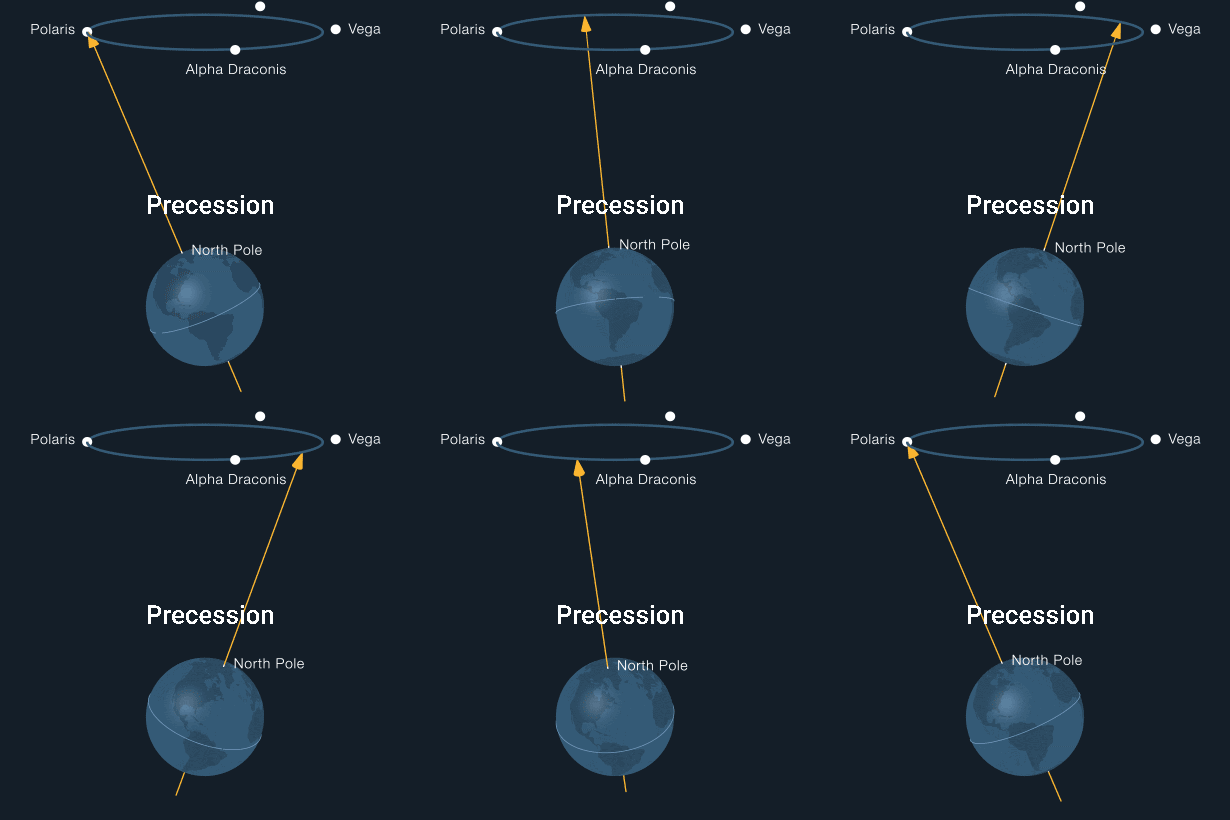 This phenomenon of the precession of the equinoxes is due to the long term cyclic wobbling in the orientation of Earth’s axis of rotation. This wobble is approximately 1 degree for every 71.6 years. The rate of change is extremely slow taking 25,772 years for a full precession to occur. The cause of this was first discussed by Sir Isaac Newton, and has since been better quantified as we have learnt more about the mechanics of the Solar System. It is now understood that the precession is caused by many sources. Most significantly, precession is caused by the gravitational effects of both the Sun and the Moon coupled with the fact that our planet is not a perfect sphere. Meaning that when the Earth is tilted, the Sun’s gravitational pull is stronger on the portion that is tilted towards it, thus creating a torque effect on the planet. This coupled with the gravitational effects of the moon, which is tilted out of plane by five degrees, causes the slow but very gradual wobble in the tilt of the Earth.
 The precession of the Earth’s axis has several noticeable effects. The first noticeable effect of this is that the positions of the north and south celestial poles appear to move in circles. The celestial poles take one complete cycle of 25,772 years to create a full circle against the backdrop of seemingly fixed stars. So while the star Polaris lies approximately at the north celestial pole, this will change over time, and other stars will become the so-called North Star. Second, the precession of the equinoxes moves slowly westwards across the sky, causing a drift in the observed position of the astronomical constellations. What this means is that each astrological star sign now contains the constellation that was formerly to the east. In some cases, the astrological star sign does not even include the constellation whose name it bears. As an example, the tropical astrological star sign of Capricorn now covers a sector of the sky which is filled with the astronomical constellation of Sagittarius.
Over time, the location of the vernal equinox will continue to move westward at approximately 50.3 arc-seconds each year. This translates to the position of the vernal equinox having shifted approximately 23 degrees westward over the past 2,000 years, and it will continue to progress each year. To understand this better, let us consider that when the astronomer Ptolemy mapped 48 constellations in the second century, the vernal equinox occurred in the constellation of Aries. Now due to the continued process of precession, the location of this equinox has shifted westward with respect to the background stars over time. The vernal equinox now appears in the constellation of Pisces, which can be proven by simple observation of the night sky or the use of various apps on your smartphone which can map the stars. Of course, we do not notice these small shifts on Earth, because they are occurring at such a relatively slow speed. But consider that by the year 4620, the vernal equinox will have shifted further westwards to be in the constellation of Aquarius.
 So the precession of the equinoxes covers the primary difference between tropical and sidereal astrology, as the latter had taken the wobble of the Earth’s axis over 25,772 years into account. The application of sidereal astrology or Vedic astrology methods will yield a constellation close to that which is observable in the sky or via your smartphone apps.
More information on True Astrology from The Life Force Institute
True Astrology - the True Astrology starter page.Astronomical Astrology - defining what is Astronomical Astrology.
A Fresh Scientific Approach - the science of Astronomical Astrology.
Precession of the Equinoxes - understanding the precession of the equinoxes.
Constellations Dimensions - the effect of the dimensions of the constellations.
Validation - how to validate Astronomical Astrology.
Encoded at Birth - how Astronomical Astrology is programmed within you.
Astrological Dates - a table of the astrological sign dates.
Search for other astrology topics on our site.
Further information
You can access our webshop for information available from The Life Force Institute. A blog is available to keep you updated with new information. Copyright © The Life Force Institute, all rights reserved.