Wrong constellation, your entire life – three systems, one truth
 The table in this article lists the primary constellations of the zodiac and provides comparative dates across three different astrological systems. The dates given for Astronomical Astrology are calculated for the year 2020, based on GMT/UTC time. As covered in the article on Astronomical Astrology, depending on your location, time zone and the year, before or after the year 2020, these dates will shift over time.
Before examining the table itself, it is worth taking a moment to understand what you are actually comparing. These three columns do not represent three different schools of thought about the same sky. They represent three fundamentally different answers to a single question: where are the Sun, the Moon and the planets astronomically, on any given date? Two of those answers are working from fixed or adjusted frameworks that diverge from direct observation. One of them, Astronomical Astrology, is working from precise mathematical calculations which reflect the sky as it actually exists.
The first column, Tropical Astrology, is the system most people in the Western world encounter when they read a horoscope in a newspaper or magazine. It assigns the Sun to Aries beginning at the March equinox each year, using the vernal equinox as its fixed starting point. This system was calibrated approximately 2,000 years ago, when the March equinox did align with the Sun’s astronomical position in Aries. However, this is no longer the case due to the precession of the equinoxes. The vernal equinox now falls with the Sun astronomically positioned in Pisces, and has done so for several centuries. Tropical Astrology does not account for this. Its dates remain anchored to a celestial map that reflects the sky of the ancient world, not the sky above you now.
The second column, Sidereal Astrology, recognised that the precession of the equinoxes was producing an ever widening gap between tropical astrology dates and actual stellar positions, and attempted to correct for this. Sidereal systems adjust the starting position to track the drift caused by precession. This is a meaningful improvement over tropical astrology, as it brings astrology considerably closer to astronomical reality. However, most sidereal systems still divide the sky into 12 equal segments of 30 degrees each, which does not reflect the unequal dimensions of the astronomical constellations. The constellations of the zodiac vary considerably in size, and the Sun spends a very different amount of time within each one as a direct consequence. A system using equal 30-degree divisions cannot accurately represent this variation.
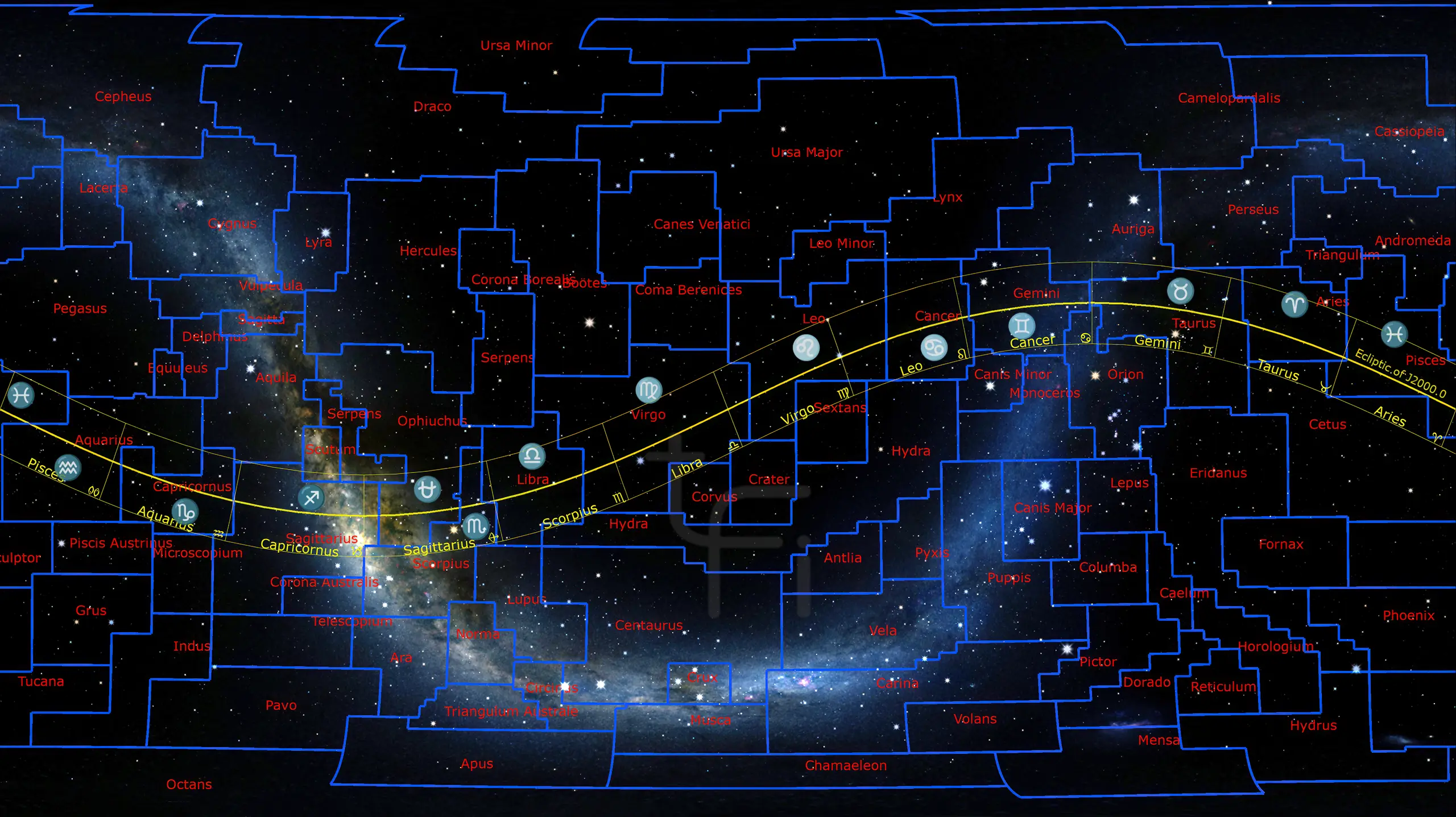
The third column, Astronomical Astrology as developed by The Life Force Institute, uses neither a fixed equinox starting point nor an equal division of the sky for only 12 constellations. It works directly from the calculated astronomical position of the Sun, Moon and planets against the actual boundaries of the constellations as they exist in the sky, thereby accounting fully for both precession and the true dimensions of each constellation. The dates in this column reflect where the Sun genuinely is, on a given day, relative to the constellation behind it as of the year 2020.
The constellation Ophiuchus in the table should stand out immediately to anyone familiar with conventional astrology. This constellation sits on the ecliptic between Scorpio and Sagittarius, and the Sun passes through it each year from approximately 1 December to 18 December during the early twenty-first century. Conventional astrology, whether tropical or sidereal, omits Ophiuchus entirely, maintaining the traditional count of twelve astrological signs. Astronomical Astrology includes it, because the Sun is observably within the constellation during that period and the energetic influence of Ophiuchus is therefore present. Leaving it out is not a matter of tradition; it is an astronomical omission and an astrological faux pas.
The inclusion of Ophiuchus in Astronomical Astrology produces one of the most striking differences visible in the table: the Sun’s time in Scorpio shrinks dramatically. In both tropical and sidereal astrology, Scorpio receives nearly a full month. Astronomically, however, the Sun passes through Scorpio in approximately seven days before entering Ophiuchus. This is one of the clearest illustrations of why constellation dimensions matter. Scorpius is, astronomically, one of the narrower constellations along the ecliptic path. Assigning a full 30 degrees or a month to Scorpio overstates the Sun’s time within that constellation considerably.
It is also worth noting what the table reveals about Virgo. In tropical and sidereal astrology, Virgo occupies a conventional month-long slot of thirty degrees. Astronomically, the Sun moves through Virgo from 17 September for a period of 44 days. Virgo is one of the largest constellations in the sky, and the Sun’s passage through it reflects that reality. The same principle applies across the entire table, where constellations have different durations. Cancer receives only 20 days, Sagittarius receives 32 days and Pisces receives 36 days for instance. These are not arbitrary figures. They are the direct result of the Sun’s transit at a constant speed along the ecliptic through each of the constellations mapped in the sky. No equal-division system can capture this variation, because equal division is an oversimplification imposed on a sky that is not equally divided.
Where the conventional astrological window differs from the astronomical one, you may have been identified with the wrong constellation for your entire life. This is not a criticism directed at those who have built an understanding of themselves through tropical or sidereal astrology. As noted in the encoded at birth article, the thoughts and beliefs you hold carry their own energetic weight, and the identity you have formed around a star sign has a genuine influence on how you experience life. Astronomical Astrology does not erase that. It adds a more precise layer beneath it, one which aligns with astronomical reality.
Now, with that context in place, here is the comparative table:
| Constellation | Symbol | Astrology (Tropical) |
Astrology (Sidereal) |
Astronomical Astrology |
| Aries | ♈ | 21 Mar – 19 Apr | 15 Apr – 15 May | 19 Apr – 14 May |
| Taurus | ♉ | 20 Apr – 20 May | 16 May – 15 Jun | 15 May – 21 Jun |
| Gemini | ♊ | 21 May – 21 Jun | 16 Jun – 16 Jul | 22 Jun – 20 Jul |
| Cancer | ♋ | 22 Jun – 22 Jul | 17 Jul – 16 Aug | 21 Jul – 10 Aug |
| Leo | ♌ | 23 Jul – 23 Aug | 17 Aug – 16 Sep | 11 Aug – 16 Sep |
| Virgo | ♍ | 24 Aug – 22 Sep | 17 Sep – 17 Oct | 17 Sep – 31 Oct |
| Libra | ♎ | 23 Sep – 23 Oct | 18 Oct – 16 Nov | 1 Nov – 23 Nov |
| Scorpio | ♏ | 24 Oct – 22 Nov | 17 Nov – 16 Dec | 24 Nov – 30 Nov |
| Ophiuchus | ⛎ | 1 Dec – 18 Dec | ||
| Sagittarius | ♐ | 23 Nov – 22 Dec | 17 Dec – 15 Jan | 19 Dec – 20 Jan |
| Capricorn | ♑ | 23 Dec – 20 Jan | 16 Jan – 14 Feb | 21 Jan – 17 Feb |
| Aquarius | ♒ | 21 Jan – 18 Feb | 15 Feb – 15 Mar | 18 Feb – 12 Mar |
| Pisces | ♓ | 19 Feb – 20 Mar | 16 Mar – 14 Apr | 13 Mar – 18 Apr |
 Looking across the three columns for any constellation, the date differences are rarely trivial. In several cases, they span three to four weeks, meaning that for a person born near the boundary between two signs, the system being used determines not just the precise degree of influence but the constellation itself. This is the crux of the difference between these three systems; it is not academic conjecture.
The dates in the Astronomical Astrology column are calculated based on the Sun’s position in 2020 and will shift slightly year on year. The Sun does not pass through each constellation boundary at the same moment each calendar year due to the ongoing effect of precession. For those checking your own Sun sign, the dates given here will be accurate to within a day or two across the years immediately surrounding 2020. If you were born very close to a constellation boundary, it is worth using one of the astronomy applications described in the validation article to confirm the Sun’s precise position on their specific date, time and location of birth. Alternatively, you can contact the Life Force Institute for a full picture.
If you were born on 1 December, for example. Under tropical astrology, your Sun sign would be Sagittarius. Under sidereal astrology, your Sun sign is Scorpio. Under Astronomical Astrology, the Sun leaves Scorpio at the end of November and is actually in Ophiuchus. Three systems, three different answers as you try to understand the energetic conditions of your birth. Most people, when they read the qualities of the constellation that Astronomical Astrology assigns them, find a recognition that the tropical assignment never quite produced.
The same consideration applies to the Moon and planets. The table above addresses the Sun sign only. Your full astrological key code includes the positions of the Moon, Mercury, Venus, Mars, Jupiter, Saturn and the outer planets at the moment of your birth, each of which will also be located within a specific constellation. Those positions are not captured in a simple date table. They require a full astronomical calculation for your precise time and place of birth, which is precisely what the Life Force Institute’s Astronomical Astrology can provide.
What this table ultimately gives you is a starting point. The sky on the day of your birth was exactly as Astronomical Astrology describes it. The only question is whether you are ready to look at it clearly.
Recommended Reading on True Astrology
True Astrology - the starter page for a unified view of Astrology and Astronomy.Astronomical Astrology - removing myths, reconnecting astrology to cosmic actuality.
A Scientific Approach - how Earth's rotation, orbit and precession impact astrology.
Precession of the Equinoxes - why Earth's wobble shifts your zodiac sign over time.
Constellation Dimensions - from 6 to 45 days, the reality most astrology ignores.
Validation - how to verify Astronomical Astrology yourself, no faith required.
Encoded at Birth - how the Sun, Moon and planets encode your defaults & reactions.
Astrological Sign Dates - three sets of astrological dates and what are the differences.
Cosmos Influences - how universal energies and planetary fields affect you.
Search for other astrology topics on our site.
Further information
You can access our webshop for information available from The Life Force Institute. A blog is available to keep you updated with new information. Copyright © The Life Force Institute, all rights reserved.