The Power of Mindful Planning
Your mental energy is like currency and you are spending it with every decision you make throughout your day. From the moment you wake, you may be unwittingly drawing from this reserve of cognitive capacity, depleting it with each choice about what to wear, what to eat, which emails to answer first and countless other trivial matters that demand your attention. By the time you finally turn towards what genuinely matters, you may have already diminished much of your decision-making power. This is the hidden cost of an unexamined life and it is sabotaging your potential in ways you may not even recognise.
Mindful planning ahead is not about imposing rigid control over every aspect of your existence or draining the spontaneity from your days. Rather, it is a strategic practice that liberates your mental bandwidth for what is truly important or what matters. When you systematically remove low-value mental noise from your daily equation, you create cognitive space and reserve your energy for important work. You stop haemorrhaging willpower on the mundane and redirect that energy towards innovation, meaningful progress on your goals and the kind of deep thinking that generates breakthrough results. Each small decision which you can hone to a simple and effective choice represents reclaimed mental energy. When you multiply this across dozens of daily choices, then extend it across weeks and months, the cumulative impact becomes substantial. You discover sharper focus, enhanced creativity, greater stamina and improved concentration.
Effective planning, however, demands genuine self-awareness. Your mental energy is not constant but fluctuates significantly throughout each day and varies across the week according to patterns which you can learn to recognise. Appropriate planning means understanding these natural rhythms and working in harmony with them rather than against them. When you understand your natural energy periods, you can choose a time which requires your sharpest thinking, strongest willpower and most creative capacity. This conscious resource allocation is not merely about productivity in the conventional sense but about honouring the reality of your human limitations whilst maximising your potential within them.
When you plan with true intention, you are making a fundamental choice about how you want to engage with your life and where you will direct your finite attention. You are acknowledging that your mental energy is a valuable resource which should not be squandered on decisions that warrant none of it. You are refusing to live reactively, lurching from one demand to the next and instead creating the conditions for your best thinking or your most meaningful work. This is how you honour your potential, rather than surviving whatever demands each day presents. The question is not whether you have enough mental energy to accomplish what matters most, but whether you are consciously directing that energy towards what is important, rather than allowing it to drain away through thousands of thoughtless choices.
Beyond the Pursuit of Happiness
The modern world has turned happiness into a commodity to be sold and consumed. Books, podcasts, courses and influencers compete for your attention, each claiming to hold the key to lasting contentment. You are told to chase happiness as though it were a destination, a prize to be won through the right techniques and various strategies. Yet for all this effort and endless consumption of advice, genuine happiness or contentment remains frustratingly distant for so many.
Daily experience tells a different story entirely, where each day brings its own emotional weather: moments of joy sit alongside periods of anxiety, excitement gives way to frustration and love coexists with doubt. This is not a failure on your part, but the natural flow of human experience encompasses the full range of what you feel. Attempting to force yourself into a continual emotional state of happiness is doomed to failure. The depth and meaning in your life come from this variety, where it should be possible to maintain multiple emotional states simultaneously, where one of those incorporates elements of happiness, joy or contentment.
Contentment arises not from pursuing happiness directly, but from how you engage with your life as it actually is. When you develop the awareness to experience your emotions without resistance, when you meet challenges with conscious presence rather than reactive patterns and when you recognise the value in ordinary moments, happiness has the opportunity to emerge. Achieving a happier state of being is not about eliminating difficult feelings or pretending negativity does not exist. Rather, you learn to work with the totality of your experience in a way that supports your genuine well-being. Through cultivating presence, developing self-awareness and practising appreciation for what is, you establish the conditions where happiness and contentment can flourish.
The real journey towards happiness moves beyond following someone else’s formula or meeting society’s expectations of how you should feel. It requires you to embrace the full truth of your own experience, acknowledging every emotion as a valid part of your existence. When you develop this acceptance and learn to work skilfully with whatever arises, you build a foundation which remains stable regardless of external circumstances or the inevitable fluctuations of daily life. Allowing you the opportunity for happiness to grow.

What is Astrological Astronomy?
A unique convergence exists where observation meets interpretation. Astronomical Astrology blends empirical astronomical wisdom with traditional astrological insights. Conventional astrology systems have become disconnected from where celestial bodies actually appear in the sky. Astronomical Astrology grounds itself in precise observation of the Sun, Moon and planets as they travel through space. The precession of the equinoxes matters, as do the true dimensions of constellations.
Traditional systems divide the sky into twelve equal segments. Astronomical Astrology rejects this approximation in favour of actual observation. Planets have complex orbits. The Moon tilts in its path. These bodies sometimes appear outside the standard zodiac boundaries, so precision and calculations matter. This focus aligns astrology with genuine cosmic mechanics rather than static symbolic systems that ignore how celestial positions shift over millennia. Through Astronomical Astrology, you gain a dynamic framework for understanding yourself in relation to the universe.
Everything in the universe follows predictable patterns. Your thoughts follow patterns. Your emotions, reactions and so much more all follow patterns. All matter and energy operate according to observable principles. Astronomical Astrology recognises this fundamental reality. The extended zodiac provides the celestial framework of thirteen primary constellations, accompanied by nearby secondary constellations. Tracking celestial bodies’ movement through these constellations gives a true picture of some of the energetic influences in your life. Subtle energetic currents shape your personality traits. They influence your responses. They affect your life events. Myth meets measurable reality, as you can gain a scientifically aligned perspective on an ancient practice.
Astronomical Astrology invites you to become aware of the energies that surround you. How do these cosmic patterns intersect with your personal experience? This practice illuminates the interplay between cosmic order and human life. Energy can be studied. Alignment can be understood if you approach astrology, not as superstition, but as a legitimate study. Through the study of Astronomical Astrology, the greater flow of the universe can be observed and applied to your life.
Not Missing Out
The fear of missing out (FOMO) appears when attention drifts away from your own experience and fixes itself on how others seem to be living. In its milder form, it nudges towards comparisons. However, in its more intense form, it erodes self-trust and replaces contentment with judgment and more. When your awareness constantly draws from external sources, especially in curated Social Media feeds, you may begin measuring your worth against moments that are artificially curated and incomplete. The unease many of us initially feel in such settings is not about absence; instead, it is about a disconnection. You want belonging, you seek inclusion, yet even if you attain all the latest status, you may still feel you are missing something. For those not attaining the status, it can quickly bring forward the spectres of judgment, envy and jealousy.
For those who get caught up in the FOMO cycle, even when you attempt to change, you may find that your attention continues scanning what others are doing. Digital life may amplify these aspects in your life, yet also support creativity, opportunity and meaningful exchange. You may discover that joy does not require constant engagement. It asks for discernment. Freedom arises when your attention is guided by intention rather than habit. In these digital spaces, you may also begin to notice that missing out is not a single experience but a collection of fears and expectations which compound with each comparison you make.
Joy itself is quieter than you may have been led to believe. It does not announce itself through approval or applause. Joy emerges when you are fully present with what resonates. You feel it as lightness, warmth and a subtle sense of safety or just simple contentment. When you begin to notice these moments, you realise they often arise in simple, unguarded experiences. Paying attention to them trains your awareness to recognise fulfilment as it happens rather than chasing it retrospectively. Joy becomes reliable when you learn to notice all the varied aspects of your life, rather than pursuing it and constantly comparing yourself to the rest of others. Over time, these moments form internal reference points that ground you when comparison attempts to pull you away from yourself.
When you return to memories of genuine contentment, you are connecting to a state of happiness that already exists within you, rather than needing to build something afresh. By revisiting these experiences with sensory awareness, you strengthen your ability to access calm and satisfaction in the present moment. This inner anchoring does not rely on external circumstances; it reminds you that fulfilment is not elsewhere or determined by someone’s endeavours or activities, which you may have viewed online. It is available through conscious attention. As this understanding deepens, the idea of missing out can begin to diminish, as long as you also practice restraint in your immersion in digital life. When you are present, life meets you where you are; nothing essential is absent and what truly matters is within reach.
The Realised Moment Is Enough
There are two questions that you may find worth asking, which can shift how any moment is perceived.
What if this moment were already whole, already holding everything needed for contentment?
What if it requires no forced action, just awareness?
Often in life, frustration appears when you focus too tightly on what seems absent, missing or unjust. Yet stepping back, considering the moment in its entirety, additional things, maybe even the thing you were seeking becomes visible. What is present begins to reveal itself in the moment. Acknowledging what exists in the here and now allows your perspective to expand and many different avenues of direction to become visible.
Relationships offer another view into this same awareness of the moment principle. Anger or disappointment may initially dominate your thoughts and emotions during difficult times. However, even within these moments, there are often emotions that may be lingering at lower intensity and are worth recognising and promoting to high prominence in your consciousness. The forgotten aspects of a relationship, the presence evident within your connections, can outweigh momentary conflict when given space to be seen.
Realise that even difficult circumstances carry unexpected offerings. Simply being alive, inhabiting this moment without reservation, is a richness of your life which can be easily missed. Life rarely presents itself as perfect. Yet more often than not, it is sufficient. Recognising this sufficiency in your life can transform your experiences without changing a single external detail.
Moments that feel calm and unremarkable can fill the ordinary with the extraordinary if you allow it. Pausing to notice light, air and the small rhythms that shape a day; all of these deepen your appreciation of your existence. Presence a form of noticing what is already complete.
Perhaps happiness is not located in some different outcome, a future shift, or an achievement still to come. Your happiness already exists, woven through these moments exactly as they are. Contentment begins when attention is here and now, rather than dwelling in what might have been or could be.
The Illusion of Control
The Master allows things to happen. She shapes events as they come. She steps aside and allows the Tao to speak for itself. Laozi
There is a belief we carry, often without question, that control is something we can grasp if only we apply ourselves. You make plans, set goals with conviction and assemble strategies with precision. Yet still, life moves on in ways you cannot expect or predict. The future refuses to be pinned down, regardless of how carefully you plan or prepare. This is the realisation of the true nature of things. This perceived sense of being in control rarely reflects what is actually happening.
Consider this. Few of us could have accurately described where we would be now, several years ago. Global shifts, economic changes, natural events and personal circumstances. They evolve and change often beyond anticipation. The idea that we can steer life with exactness offers comfort, but not truth. We prefer the feeling of control because uncertainty unsettles us.
The illusion reveals itself in subtle ways. It appears when we try to shape how our children will turn out. It surfaces when we measure every detail of daily existence, tracking productivity, health, progress, believing that data can contain the full scope of human experience. It emerges when we manage people intensely, forgetting the depths of emotion and unpredictability that define us. It lives in excessive planning, in the assumption that outcomes can be engineered rather than encountered.
When the illusion you hold regarding life and the future changes, a different question arises. How does life actually unfold when we stop trying to control every outcome?
Picture a fish in open water. The seas and oceans of this world are vast, always moving, utterly uncontrollable. The fish does not attempt to command the currents. It responds. It adapts. It nourishes itself. It continues. There is no struggle for mastery of the whole ocean, simply engagement with what is present. Life unfolds through responsiveness, not resistance.
Humans exist in their environment no differently, yet thought creates the expectation of dominion and control of life. When that expectation changes, your experience of life transforms. Life continues its movement and attention shifts from prediction to presence. Action still happens, but it arises from values and genuine interest rather than attachment to specific results. Effort follows what is meaningful or required in the present, not anxiety about where it must lead.
In practise, this feels like allowing life to unfold one step at a time. Attention rests where you actually are. While being aware and planning for the future, you need not be consumed with it so that it overtakes the present.
This approach may feel unfamiliar, particularly in cultures that value productivity, ambition and relentless improvement and change. It may even feel uncomfortable initially. Yet living under the illusion of control carries its own costs. Tension. Frustration. A persistent sense that something is not quite right are all underlying aspect of a life lived too tightly.
For those willing to explore another way, there is a different kind of freedom, the freedom of participation.
What Truly Matters
Simplicity is not deprivation but liberation. It represents releasing the unnecessary to create space for what is truly essential or important in your life. In a culture that equates accumulation with success, choosing simplicity becomes a conscious act of going against the flow.
This practice requires repeatedly asking yourself questions: Does this align with my deepest values? Does this nourish my being or merely distract me? Am I accumulating from genuine need or unconscious habit? These questions help you clear away clutter across all dimensions: physical, mental, emotional and spiritual. Through this clearing, you reveal what truly deserves your limited time and energy.
The practice is not about minimalist aesthetics but should instead be applied to all aspects of life. You make clear and conscious choices about what is required and needed, not what is wanted or deserved. Simplicity does not mean conforming to identical preferences or following prescribed formulas. It means gaining clarity about your unique priorities and arranging your life accordingly. This offers the opportunity for greater balance because you are no longer scattered across countless superficial concerns. Instead, you focus on cultivating depth in the few areas that truly matter to your awakening and well-being.

Befriending Your Shadow
Within each of you live aspects you have deemed unacceptable, qualities which you have exiled to the darkness because you feared what others might think, or because you absorbed messages that these parts were wrong. Yet these shadow aspects do not disappear through suppression; they merely operate unconsciously, influencing your choices and reactions in ways which you may not fully comprehend. The journey of integration requires courage to face what you have hidden and compassion to examine them.
When you shine awareness on your shadows without judgment, you can reclaim enormous amounts of energy previously devoted to keeping these shadows at bay. You may then discover that what you rejected often contains gifts: your anger may protect boundaries, your sadness may deepen empathy, your fear may heighten discernment. Understanding the shadow is not about acting on every impulse, but about building a conscious awareness with all that you are, recognising that wholeness includes the light and the dark. By acknowledging and processing these hidden aspects rather than suppressing them, you prevent them from festering and causing harm, empowering you to move forward with greater authenticity, truthfulness and emotional freedom.

Distinguishing Ego from Intuition
As you progress on the spiritual path, a crucial challenge arises: how do you know whether guidance comes from genuine intuition or from ego masquerading as wisdom? The ego can be remarkably sophisticated, masking its desires in spiritual language and creating elaborate justifications. True discernment requires honest self-inquiry and a willingness to question even your most cherished insights. Without this awareness, you risk being controlled by unconscious patterns rather than guided by authentic wisdom.
Intuitive guidance typically feels spacious, peaceful and unattached to specific outcomes, while ego-driven thoughts often carry urgency, fear, or a sense of superiority. Learning to distinguish between these voices is not about achieving perfection but developing an increasingly refined sensitivity to the quality of different inner experiences. This skill deepens through practice, through examining the fruits of your choices and through acknowledgement when you have mistaken ego for essence. By cultivating this discernment, you gain greater clarity and control over your spiritual journey, empowering you to make choices aligned with your authentic self rather than reactive patterns. This practice leads to more truthful experiences and a deeper connection to your inner knowledge.

Understanding Energy Vampirism
Some individuals and environments can drain your Life Force subtly or overtly, creating fatigue, emotional turbulence, or cognitive confusion. The recognition of energy vampirism is vital for maintaining balance, presence and vitality, especially as you begin to grow on your awakening journey.
Energy vampirism can manifest as emotional manipulation, excessive dependency, or even environmental clutter that weighs upon your energetic field. Awareness of your personal energetic boundaries and deliberate restoration practices is essential to preserving your vitality and maintaining a connection to your inner self.
In daily life, you should strive to identify triggers that deplete your energy and implement protective strategies accordingly. Visualisation of energetic boundaries, conscious detachment, grounding practices and mindful engagement with people and environments all serve to protect the energy of your Life Force. Regular replenishment of your personal energy through meditation, breathwork, or time in nature strengthens your resilience against draining influences.
By protecting your vital force, you can assist yourself in maintaining mental clarity, emotional balance and conscious presence in all interactions. Energy preservation is not isolation or withdrawal from the world. It is conscious alignment with Universal Force, allowing your Life Force to circulate freely and harmoniously without being unnecessarily drained from your being. It is knowing when you are being drained and immediately instigating actions to stop the outward flow of energy from your being. The longer you allow the energies of your Life Force to be drained, the harder it will become to stop the flow.
So Quiet You Can Listen
In daily life, moments of genuine stillness are rare. There is almost always movement, noise, or a stream of information filling every gap that was not previously full. Work, travel, smartphones, constant engagement. This extent of being busy has become deeply human, yet it leaves little room for reflection or true awareness.
What happens when you allow yourself to become quiet? Even a few minutes can feel different if you have not had the opportunity for a while. You may begin to notice subtleties in your surroundings, a shift in your energy, or an awareness that was previously hidden. Quiet is not empty. It is alive with experience waiting to be discovered.
Becoming quiet does not require formal meditation, although meditation is one path. It can be as simple as a slow walk in nature, watching the light change at sunset, or lying in a hammock and feeling the breeze. It is about presence, not performance. It is about allowing yourself to exist without the pressure to do or consume.
Stepping away from technology, even briefly, supports this awareness. Let go of reading, listening, scrolling and scrolling again. Just moving slowly or sitting in stillness lets perception return to its natural pace. It allows the mind to rest for a brief moment from constant stimulation.
Quiet also asks that you release the need to be productive or entertained. There is no requirement to achieve, impress, or feel a certain way. You may notice boredom, restlessness, or even discomfort arise. That is expected as your mind will rebel against you taking control of life to really experience. Allowing existence to exist without interference creates space for truly being in the moment.
It is in these moments that some of the richest experiences of life emerge. Stillness and quiet are rarely rewarded in a culture that prizes output, yet they carry their own wisdom. Listening in stillness reveals life in ways that noise and activity often obscure.
When you make room for quiet, you begin to hear what the world and your own attention have to say. It is not about control or answers. It is about connection, clarity and the restoration that comes from simply being present.
“In stillness, the world is restored.” Lao Tzu
The Wisdom of Not Knowing
Our minds crave certainty, typically constructing elaborate belief systems to protect us from the vulnerability of not knowing. Yet the truth is that uncertainty is the ground of existence itself. You can never truly know what the next moment will bring or whether your interpretations of reality are accurate. When you relax your desperate grip on knowing, a newfound peace can emerge, along with an openness to discovery that transforms your experience of life.
The spiritual path of not knowing is paradoxically more stable than clinging to fixed ideas, because it moves with reality rather than resisting it. This does not mean abandoning discernment or becoming passive. Rather, it means holding your views lightly, remaining curious about perspectives different from your own and recognising that mystery is not a problem to be solved but the very nature of existence and the universe. In this not knowing, intuition and wisdom have room to arise. By releasing the need for absolute certainty, you create space for deeper understanding and authentic connection with the present moment, allowing you to navigate life with greater clarity, flexibility and inner peace.
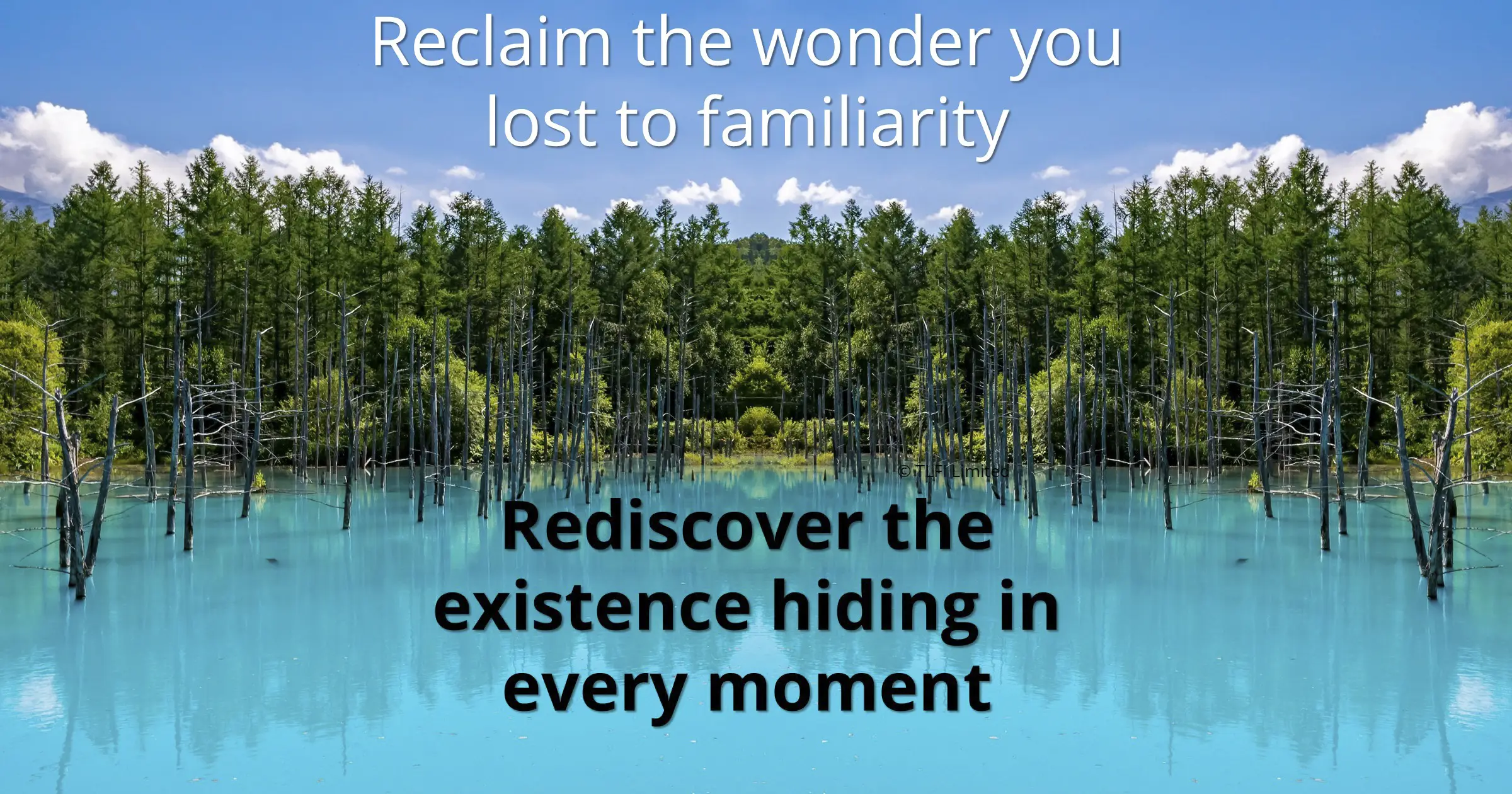
Cultivating Wonder
You once possessed a natural capacity for wonder, seeing each experience as new and remarkable, approaching the world with fresh eyes that found magic in ordinary things. Children live in this state effortlessly, marvelling at insects, captivated by clouds, delighted by patterns of light on water. Yet somewhere along your journey into adulthood, you may have lost this quality through the grinding familiarity of repeated experiences and the relentless pace of living. Along the way, wonder became categorised as childish, something to be outgrown along with fairy tales and imaginary friends, dismissed as impractical daydreaming that has no place in adult life. This loss represents one of the great tragedies of conventional maturity, yet few people recognise what they have sacrificed in the name of growing up.
Wonder is not childish, but rather it can be a sophisticated spiritual state that recognises the astonishing miracle of existence itself. When you truly contemplate that anything exists at all rather than nothing, that consciousness arose from matter, that you somehow became aware of your own awareness, that the universe organised itself into stars and planets and eventually into beings capable of questioning their own existence, you encounter genuine wonder. This is not naive optimism or denial of reality’s difficulties but a choice to remain aware of existence’s mystery and beauty, even as you handle necessary tasks and navigate genuine challenges. You can acknowledge suffering whilst still marvelling at the intricate complexity of a single flower. You can face difficulties whilst remaining astonished that you are here to face them at all. Wonder does not require perfect circumstances but rather a shift in perception that refuses to take existence for granted, simply because you have become accustomed to it.
Wonder must be cultivated deliberately because your default mode moves towards familiarity and automation. You can actively seek wonder in so many ways every day. Wonder can be found in nature’s endless creativity, in human ingenuity or artistic expression, in the miraculous workings of your own body and in the mysterious depths of your own mind, to name just a few. Take a moment to simply watch how your hand moves according to your intention, consider how your brain translates chemical signals into the experience of taste, or observe how thoughts arise seemingly from nowhere. These everyday things become invisible through repetition unless you consciously choose to see them. This practice of simple observation counteracts the deadening effect of routine that turns your life into an endless series of automatic responses.
When you approach existence with wonder, you are essentially saying yes to the adventure of being alive, embracing its uncertainty and perpetual newness, rather than trying to make everything known, controlled and safely predictable. Wonder opens you to possibilities, where cynicism sees only limitations. It keeps you curious and allows you to be surprised, whereas jadedness expects disappointment. Wonder is the antidote to the cynicism that poisons so many lives, the doorway back to the enchantment that makes existence worth experiencing rather than enduring. This does not mean forcing false positivity or pretending difficulties do not exist, but rather refusing to allow hardship to close your eyes to the nature of the reality you inhabit. You can hold both truth and wonder simultaneously, acknowledging what is difficult whilst remaining astonished by what is beautiful and in this balance, you discover a way of being that neither denies reality nor succumbs to the weight of taking it all for granted.

Find Calmness in Between
Have you noticed how the harder you try to calm a chaotic mind, the more restless it can become? When actively trying to calm a busy mind backfire, focusing on the spaces between your thoughts offers a more effective path to relaxation and focus. These natural gaps, present even in the most chaotic minds, can provide you with an anchor for your attention. By observing and expanding these gaps, you create space for greater calm, allowing thoughts to naturally recede and leading to a more peaceful and centred state of being. Through this practice, you can find tranquillity amidst mental noise, leading to greater clarity, focus, and overall well-being.

Your Thoughts Shape Reality
Your thoughts are more than mere biological signals. Thoughts are powerful energy, shaping your perception and potential. Right now, as you read these words, light patterns hit your retina, and within milliseconds, intricate neural networks in your brain decode meaning. This incredible complexity reminds us that each thought holds the power to spark change. Imagine what your thoughts could achieve when aligned with clear intent and purpose!