Unequal constellations and missing signs – the reality most astrology ignores
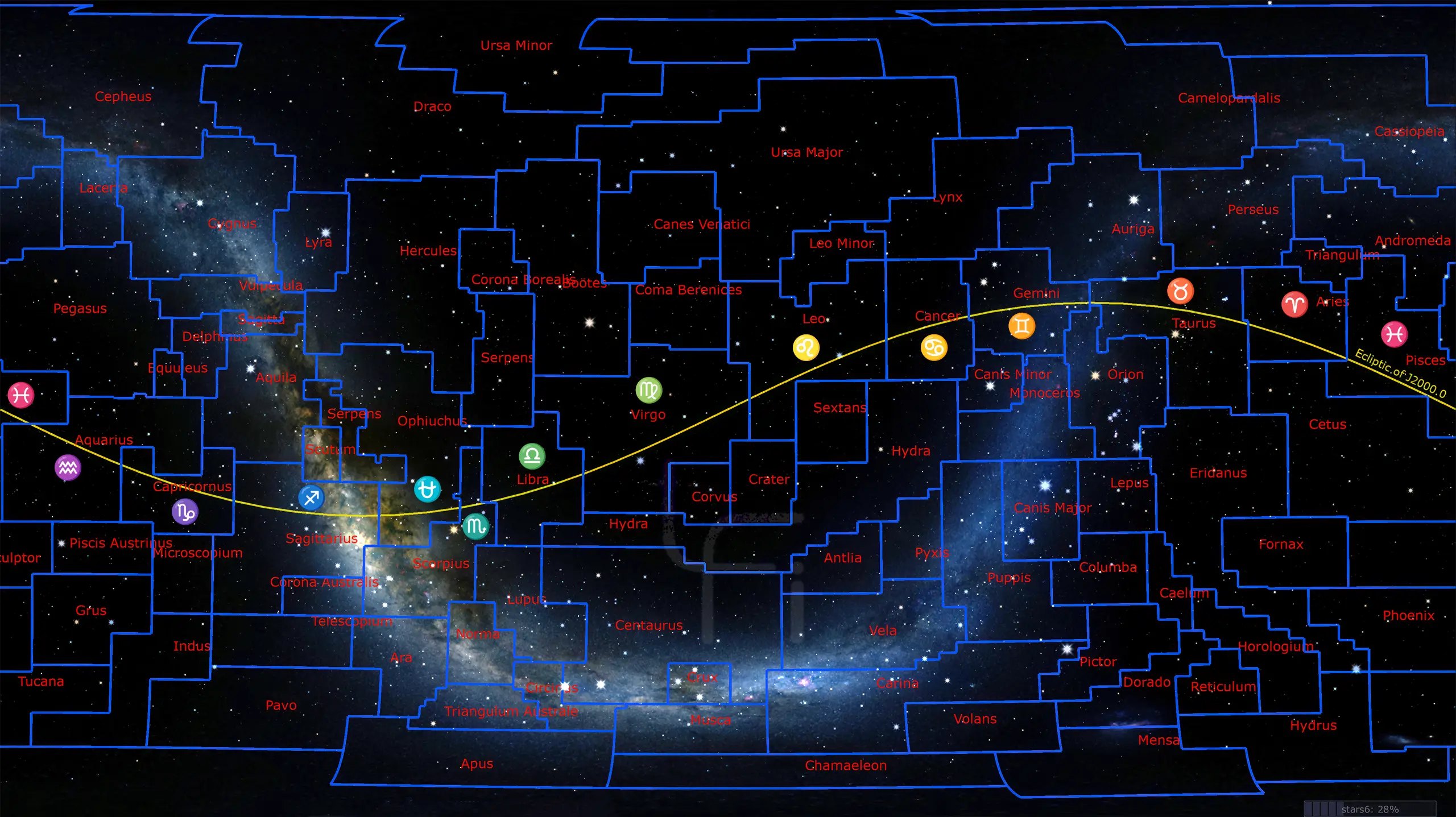 If you have been able to comprehend the complexities of the precession of the equinoxes, there is a further complication to add into the mix. The constellations as marked in astronomical maps are not twelve equal segments of 30 degrees each. As previously noted, the ecliptic contains thirteen primary constellations through which the Sun passes, and up to eighteen constellations through which the Moon and planets may transit.
This topic is not a minor technical footnote. It is one of the two central reasons why conventional astrology, in both its tropical and sidereal forms, do not correspond to the observable sky. Precession accounts for the drift over time. Constellation dimensions account for the unequal size of the constellations and different angles of transit that exist right now, regardless of which era you are born in. Both must be addressed before a system of astrology can honestly claim to reflect astronomical reality and bring astrology back into alignment.
The neat 30-degree arcs of sky assigned to each sign in tropical and sidereal astrology do not reflect the actual size, boundaries or positions of the real constellations. Astronomical Astrology uses the constellation boundaries, as defined by the International Astronomical Union (referred to hereafter as the IAU) so that it not only accounts for the precession of the equinoxes, but also explains the observable positions of the Sun, Moon and planets within their respective constellations at any given time.
The IAU constellation boundaries are the internationally agreed delineations used by professional astronomers worldwide to identify which region of the sky any celestial object occupies. They were formally standardised in 1930, based on work by the Belgian astronomer Eugène Delporte, and they follow lines of right ascension and declination on the celestial sphere, rather than the neat angular arcs that astrological tradition preferred. Using these boundaries means that Astronomical Astrology is working from the same definitions as modern observational astronomy. There is no separate or competing view of the constellations. It is the same map, one united view of Astronomy and Astrology.
When a conventional astrological chart tells you the Sun is in a particular sign, it is placing the Sun within one of twelve equal 30-degree segments of a notional celestial sphere. When Astronomical Astrology states the Sun is within a particular constellation, it means the Sun is astronomically located within the IAU-defined boundary of that constellation, as any observatory or astronomy application would confirm. These are not equivalent claims. The difference between traditional forms of astrology and astronomy is measurable.
An Unequal Sky
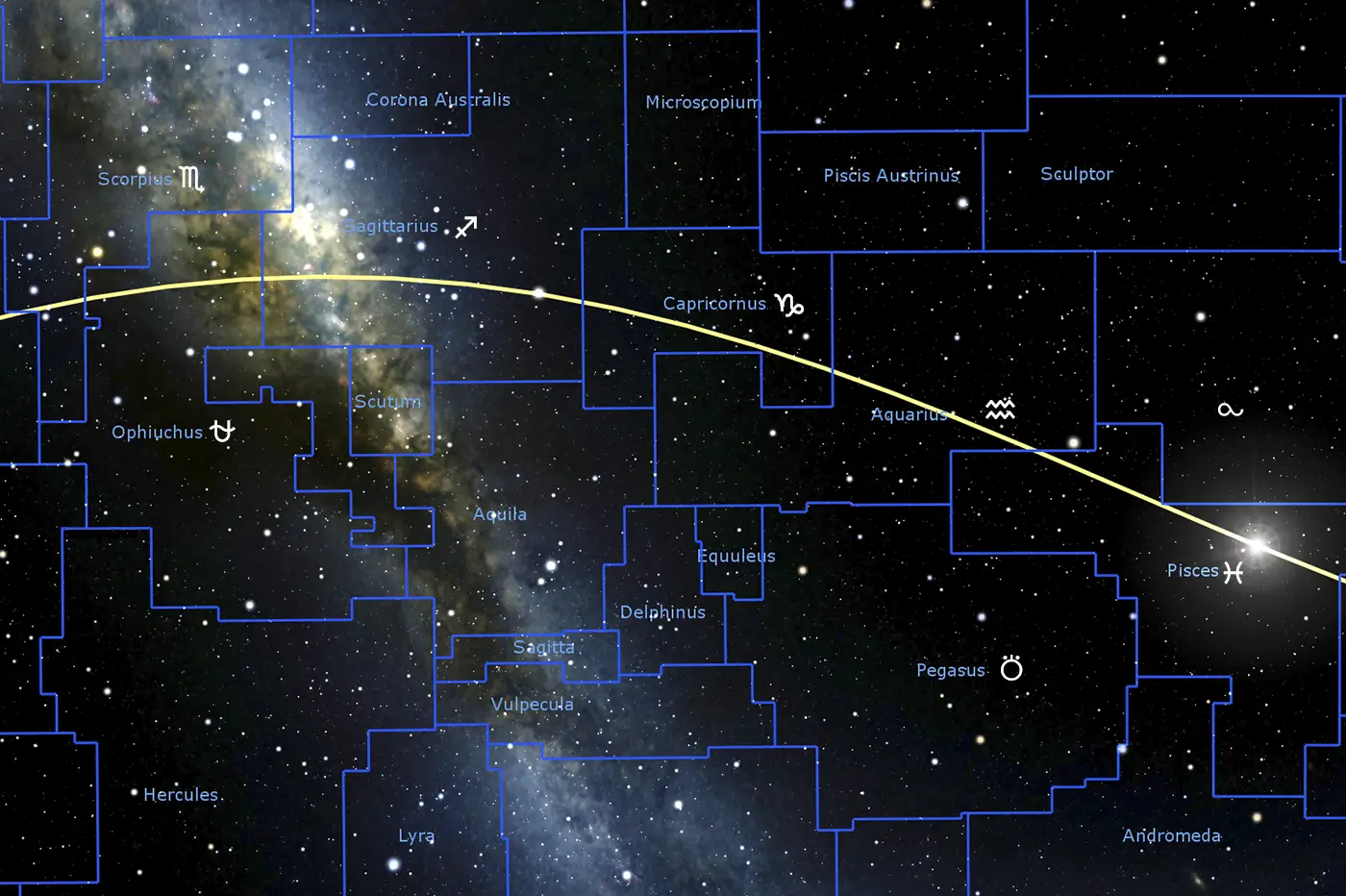 The first thing to observe about the IAU constellation boundaries is that the constellations are not equal in size. Pisces, for example, occupies a considerably larger area of sky than Cancer. Virgo is one of the largest constellations in the entire sky and not just along the ecliptic. Scorpius, by contrast, is notably narrow in the area of the ecliptic path, being squeezed between the adjacent regions of Libra and the often overlooked Ophiuchus.
This variation in the size of each constellation is a reflection of how the ancient astronomers, across different cultures and centuries, drew the figures they identified in the sky. The constellations vary enormously in physical scale according to the primary stars which make up the shapes of each constellation. A scorpion occupies far less visual territory than a water-bearer or a pair of fish. The sky was not designed for the convenience of a twelve-sign equal-division system. It was observed and recorded as it appeared, in all its irregular, asymmetrical reality.
The implications for true astrology are direct and irrefutable. If the constellations vary in size, and the Sun travels along the ecliptic at a consistent apparent speed, then the Sun must spend a different amount of time within each constellation. A larger constellation means a longer solar transit. A narrower one means a shorter passage. The Sun cannot spend 30 days in each constellation if the constellations are not each 30 degrees wide. The arithmetic is straightforward, and it breaks the foundation of every equal-division astrological system ever devised.
The Angle of Transit
The second important factor is that the Sun, Moon and planets do not always travel squarely through each constellation. They traverse each one on a perceived angle and at varying elevations relative to the constellation’s boundaries. The ecliptic cuts through some constellations near their centre, through others near their edges, and at differing angles depending on the orientation of the constellation’s IAU boundary relative to the ecliptic plane.
Picture the ecliptic as a road cutting through a series of fields of unequal width. In some fields, the road passes through the widest part of the land, covering maximum distance before reaching the next boundary. In others, it clips a narrow corner, crossing the boundary fence again in a very short distance. The traveller on that road, in this case the Sun, Moon or a planet, moving at a constant speed, will spend varying amounts of time in each field. What changes is the width of the territory being crossed.
This angular variation compounds the effect of differing constellation sizes. A constellation that is large overall might still produce a relatively brief solar transit if the ecliptic cuts through only a narrow portion of its IAU boundary. Conversely, a constellation that appears moderately sized on a star map might produce a longer transit if the ecliptic traverses it at an oblique angle, thus covering a greater distance within the constellation’s boundary. Both the overall dimensions and the geometry of transit must be calculated together to determine how long the Sun, Moon or a planet actually spends within any given constellation.
This results in the Sun, Moon and planets all spending measurably different amounts of time travelling through each astronomical constellation. When you take all of these factors into consideration, you find that each constellation commands a varying arc of sky, meaning its period of dominion is not a consistent 30 days but differs quite considerably between all constellations.
The Absent Constellations
Any true account of constellation dimensions along the ecliptic must address the Ophiuchus constellation. This constellation sits on the ecliptic between Scorpius and Sagittarius, and the Sun passes through its IAU boundaries from approximately 1 December to 18 December each year, a period of 18 days. This is not a marginal or borderline case, the Sun is unambiguously within Ophiuchus during that period, as any astronomy application, ephemeris or observation of the sky will confirm.
Conventional astrology omits Ophiuchus entirely, because its inclusion would require either abandoning the twelve-sign structure or redistributing the existing signs to accommodate a thirteenth. Neither option has been attractive to systems built around the number twelve and equal divisions of thirty degrees of sky. Astronomical Astrology does not have this problem, because it is not built around a predetermined count of signs. It is built around the observable sky, and the observable sky contains Ophiuchus on the ecliptic. The constellation is therefore included, as it must be.
The energetic qualities of Ophiuchus are distinct from those of either Scorpius or Sagittarius. People born between 1 and 18 December are not carrying a blended or transitional energy from adjacent constellations. They are born with the Sun within Ophiuchus, and their solar key code reflects that constellation’s specific character. Leaving this out is an omission.
Similarly, there are other constellations which the Moon and planets will occasionally transit on the ecliptic which are also absent from traditional astrology systems. These additional constellations include: Auriga, ⧜Cetus, ⚯ Orion, ⛣ Pegasus, ⟇ Sextans. Their omission creates gaps in the understanding of the cosmic energies that influence you and the astronomical key codes of those born during these transits.
The Combined Effects
The full extent of these variations are striking once you see the actual figures. At one end of the range, Scorpius holds the Sun for approximately 6.5 days. At the other end, Virgo retains the Sun for close to 45 days. Between these two extremes, every other constellation falls somewhere along that range, with Cancer receiving around 20 days, Sagittarius around 32 days, and Pisces around 36 days.
To put the Scorpius figure in concrete terms: if you were born on 24 to 30 November depending on the year, your Sun was astronomically in Scorpius at the time of your birth. If you were born on 1 December, it had already moved into Ophiuchus. The entire astronomical window for Scorpius, as a Sun sign, spans less than a single week. Both Tropical Astrology and Sidereal Astrology assign Scorpio a full month. The discrepancy between those two figures is not a rounding error. It is a fundamental misrepresentation of the actual observable reality.
The Virgo figure is equally telling in the opposite direction. Astronomically, the Sun is within the IAU boundaries of Virgo from 17 September through to 31 October, a period of 44 days. Tropical astrology assigns Virgo from 24 August to 22 September, a window that does not even overlap with the astronomical period in the same calendar month. A person born on 10 October, placed firmly in Libra by every tropical chart ever drawn for them, is in fact a Virgo in astronomical terms. The energetic character of Virgo and Libra are not interchangeable; that is a significant misassignment.
Why This Changes the Entire Picture
When accounting for the actual dimensions of the constellations and the angle of transit, it becomes possible to calculate precisely the degrees of sky each one occupies along the ecliptic. Combining this with the precession of the equinoxes produces an astrological system that aligns exactly with the observable sky and with the science of astronomy.
These corrections all work together rather than independently. Precession tells you where to position the starting point of the Sun’s annual cycle against the background of the stars, accounting for the stellar drift that conventional tropical astrology ignores. Constellation dimensions then tell you, from that correctly positioned starting point, how long the Sun actually spends within each constellation before crossing its IAU boundary into the next. Apply both corrections and the result is a system whose dates and positions can be verified against direct observation at any moment. Neither correction alone is sufficient as evidenced by Sidereal astrology, which applies precession correction but retains equal 30-degree divisions. Its dates are closer to astronomical reality but still not accurate. A notional system that used real constellation dimensions but ignored precession would equally be inaccurate.
Astronomical Astrology applies both, which is why its stated positions match reality. This is what makes the system verifiable. You are not being asked to accept a theoretical framework on trust. The positions of the celestial objects exist in the actual sky, calculated from the same data that any professional astronomer or planetarium software would use. The dimensions of the constellations are not an interpretation. They are a measurable, mappable feature of the celestial sphere, and they have been precisely defined by the IAU.
Understanding this also reframes how you think about astrology. Your Sun sign under Astronomical Astrology is not the product of a calendar convention or a symbolic tradition. It is the constellation that was actually behind the Sun at the moment you were born, determined by boundaries that professional astronomy has agreed upon and that the observable sky confirms. The same applies to the Moon and every planet which occupied a specific constellation at the moment of your birth, and that constellation’s boundaries are real, measurable and verifiable. Your astrological key code, which is encoded at your birth when properly calculated, is grounded in that actuality from start to finish.
More information on True Astrology from The Life Force Institute
True Astrology - the True Astrology starter page.Astronomical Astrology - defining what is Astronomical Astrology.
A Scientific Approach - the science of Astronomical Astrology.
Precession of the Equinoxes - understanding the precession of the equinoxes.
Constellations Dimensions - the effect of the dimensions of the constellations.
Validation - how to validate Astronomical Astrology.
Encoded at Birth - how Astronomical Astrology is programmed within you.
Astrological Dates - a table of the astrological sign dates.
Search for other astrology topics on our site.
Further information
You can access our webshop for information available from The Life Force Institute. A blog is available to keep you updated with new information. Copyright © The Life Force Institute, all rights reserved.