The Realised Moment Is Enough

There are two questions that you may find worth asking, which can shift how any moment is perceived. 

What if this moment were already whole, already holding everything needed for contentment?

What if it requires no forced action, just awareness?

Often in life, frustration appears when you focus too tightly on what seems absent, missing or unjust. Yet stepping back, considering the moment in its entirety, additional things, maybe even the thing you were seeking becomes visible. What is present begins to reveal itself in the moment. Acknowledging what exists in the here and now allows your perspective to expand and many different avenues of direction to become visible.

Relationships offer another view into this same awareness of the moment principle. Anger or disappointment may initially dominate your thoughts and emotions during difficult times. However, even within these moments, there are often emotions that may be lingering at lower intensity and are worth recognising and promoting to high prominence in your consciousness. The forgotten aspects of a relationship, the presence evident within your connections, can outweigh momentary conflict when given space to be seen.

Realise that even difficult circumstances carry unexpected offerings. Simply being alive, inhabiting this moment without reservation, is a richness of your life which can be easily missed. Life rarely presents itself as perfect. Yet more often than not, it is sufficient. Recognising this sufficiency in your life can transform your experiences without changing a single external detail.

Moments that feel calm and unremarkable can fill the ordinary with the extraordinary if you allow it. Pausing to notice light, air and the small rhythms that shape a day; all of these deepen your appreciation of your existence. Presence a form of noticing what is already complete.


Perhaps happiness is not located in some different outcome, a future shift, or an achievement still to come. Your happiness already exists, woven through these moments exactly as they are. Contentment begins when attention is here and now, rather than dwelling in what might have been or could be.

What Truly Matters

Simplicity is not deprivation but liberation. It represents releasing the unnecessary to create space for what is truly essential or important in your life. In a culture that equates accumulation with success, choosing simplicity becomes a conscious act of going against the flow.

This practice requires repeatedly asking yourself questions: Does this align with my deepest values? Does this nourish my being or merely distract me? Am I accumulating from genuine need or unconscious habit? These questions help you clear away clutter across all dimensions: physical, mental, emotional and spiritual. Through this clearing, you reveal what truly deserves your limited time and energy.

The practice is not about minimalist aesthetics but should instead be applied to all aspects of life. You make clear and conscious choices about what is required and needed, not what is wanted or deserved. Simplicity does not mean conforming to identical preferences or following prescribed formulas. It means gaining clarity about your unique priorities and arranging your life accordingly. This offers the opportunity for greater balance because you are no longer scattered across countless superficial concerns. Instead, you focus on cultivating depth in the few areas that truly matter to your awakening and well-being.

Tune into Happiness: Raise Your Vibe, Elevate Your Life

Good vibes represent more than just catchy tunes; good vibrations are actually a pathway to a happier, more fulfilling life. Every thought and emotion vibrates at different frequencies, affecting you primarily when you resonate at a matching vibration. When your thoughts or components of your being resonate with a particular frequency (your vibe), you will experience the corresponding emotion. The proverbial gold nugget there is that negativity affects you if you match its groove by vibrating at a similar level – it cannot drag you down unless you align with it or have some component of your being that resonates at a sympathetic frequency.


When negativity strikes or begins to creep in, actively shift your mindset to positive thoughts and experiences by embracing uplifting good vibrations to elevate your frequency and regain control of your emotional well-being. You have the power to choose positivity and rise above negativity at any time.

Shift Your Focus for Health and Happiness

Do you often find yourself focusing on the negative? Studies show that optimism isn’t just about feeling good – it is linked to better physical health and emotional well-being. Quiet simply, people who regularly express positive thoughts and emotions have a reduced risk of illness and generally lead a more balanced and productive life. Positive psychology goes beyond just thinking happy thoughts; it helps you develop positive emotions, experiences, and character traits like loyalty, humility, and integrity. It doesn’t ignore life’s challenges but provides a framework for understanding human experience and fostering positivity. By embracing positive psychology, you can improve your mental health, and enhance your life by focusing on what strengthens you.

Rewiring Your Brain for Happiness

Our brains tend to naturally focus on the negative, an evolutionary habit that skews our perception of life. To break free, start deliberately noting the good moments and positive experiences, big or small. Actively counting, remembering, and seeking out happy or positive moments allows you to counterbalance this negativity bias and cultivate a more positive mindset. By actively counting your wins and savouring positive experiences, you will shift your mindset and boost your mental well-being, fostering a greater sense of happiness and fulfilment.

Choose Your Words Wisely for Happiness and Well-Being

Your thoughts carry energy, shaping your world. Your words and actions impact not only yourself and others but also influence the world around you. Realise that negative thoughts about others ultimately harm you as well. Mindful communication is so very important. Choosing not to have the “last word” or “win” every argument, especially when upset, projects positive intentions and protects cherished memories from being overshadowed by negativity. This practice encourages greater self-awareness, fosters more genuine interactions, and ultimately contributes to your happiness and the well-being of those around you.

The Transformative Power of Gratitude

The transformative power of gratitude extends beyond mere words; it can be a catalyst for invoking change in your life and a potent antidote to negativity and discontent. Gratitude is not just an emotion, it is a proactive stance that involves expressing appreciation and reciprocating kindness. It can be seen as being thankful and appreciative of the positive aspects of life, however, it is often overlooked as a simple virtue. Cultivating gratitude can have a positive impact on your well-being, though it is important to be aware that it requires a shift from passive acknowledgement to active engagement in many aspects of your life.

The act of expressing gratitude is a powerful catalyst for change. It shifts the focus from what you lack to the abundance that surrounds you, transforming your perception of life’s circumstances. By acknowledging the good in your life, you cultivate a sense of optimism and hope, enabling you to approach challenges with greater resilience and determination.

One of the most impactful ways to express gratitude is through the gift of our time. It is a gesture that conveys care, concern, and a genuine desire to connect with others. Spending quality time with loved ones, sharing experiences, and simply being present in their lives strengthens bonds and builds deeper understanding. These moments of connection create lasting memories, and nurture a sense of belonging, enriching your lives in ways that material possessions never can. Whether it is sharing a meal, watching a movie, or offering a listening ear, making time for others demonstrates your appreciation for their presence in your life. And when difficult times arise, offering your help, encouragement, and support is a tangible expression of gratitude that can make a world of difference.

Gratitude is not merely a fleeting emotion or temporary expression; it can and does cultivate habits that shape your outlook and experiences.  It becomes a dynamic force that shapes relationships and moulds your well-being. Gratitude transcends the unthinking expressions of thanks, evolving into a transformative energy that creates genuine connections and fortifies connections with others.  As you incorporate gratitude into your life, you will discover a newfound appreciation for life’s simple gifts, transforming the ordinary into the extraordinary.

A Dog’s View on Life

Animals of all kinds can bring us so much joy, not only when things are going well, but also when you feel pain and are suffering. A dog, or “Man’s best friend” can be a true and faithful companion through thick and thin. You look to your pets when you are ready to play and laugh, and they instinctively know when you need their support. You may also realise these are lessons right there in front of you if you care to pay attention. Here are some of the ways you can be the person you want to be if you take a dog’s view.

Dogs live for the moment and so can you. You can appreciate every moment as it comes, and be grateful for what you have. When you live in the present, you can have more enthusiasm, joy for life, and less worry. You can spend time regretting the past and worrying about the future, but the solution will not be found that way. Spinning your wheels thinking about things that you cannot change is not productive.

Find balance in life. Notice how well a dog does when their life is balanced. Dogs need their exercise, a dose of love, and structure to their daily routine, and so do we. When you balance your life, the stress fades into the background and you enjoy life that much more.

Make every day special. Have you ever noticed how a dog finds everyday life exciting? They can’t wait to go for their walk, see you come home, or greet a visitor. You can learn so much by observing how your pets have enthusiasm for the simple joys of everyday life.  Sometimes you can let days go by and get swallowed up in your routine. Every day gradually seems the same and your excitement drains away. Like the dog, every day can be special for you as well. When you take the time to look, you may find your joy is still there waiting to be rediscovered.

Trust your intuition. Dogs understand what is going on beneath the surface, as they are led by their instincts and rely on their gut reactions. You have these clues as well, but many of us have not developed or have lost touch with our intuition. Hone in on your intuition and it will help guide you through life.

Set clear boundaries. In your relationship with your dog, when the rules are clear, and enforced consistently, your pets do well and know what is expected of them. Otherwise, they are confused about what is acceptable behaviour.  The same can be said for your relationships with other people, clear and consistent communication is a key to understanding.

Forgiveness is a virtue. In the life of your dog, have you ever noticed how quickly you can be forgiven for accidentally stepping on a tail, for example? Your dog is less likely to hold a grudge or worry about what happened yesterday, they are more willing to be focused on the present moment. Forgiveness may be something you consider, but for us as humans, it is often difficult to really feel and carry out. You continue to blame others for how you feel, whereas forgiveness gives you back the power to move on and live your life.

Find your purpose. When dogs are given a task or something to do, they typically express happiness and satisfaction. As humans, we need to find our purpose as well. When you take the time to discover your purpose in life, you feel more fulfilled, and your life feels more meaningful.

A Game of Snakes and Ladders

Navigating life can be akin to a game of snakes and ladders. Just as players encounter both snakes and ladders on the board, you experience the ebb and flow of positive and negative circumstances. It is a path intertwined with chance and choice, where the twists and turns can either elevate or set you back and this is just the board game. Amidst such unpredictable encounters, the power to navigate this game and life itself lies within your ability to live in the moment and cultivate a positive outlook that transforms setbacks into stepping stones. The same should be said about the game of life, which consists of trials and triumphs, mirroring the snakes and ladders of the board game.

Maintaining a positive outlook acts as a transformative force, becoming a ladder that propels you forward, even in the face of setbacks. When confronted with a metaphorical snake, whether it be a personal or professional setback, a positive outlook will enable you to view it as a temporary move backwards or sideward rather than an insurmountable obstacle. When faced with adversity or challenges in life, it can often be difficult. Try to view it as a chance for growth, a test of resilience, and an opportunity to learn from your experiences. This shift in perspective can allow you to get back into the game of life.

In the game of snakes and ladders, an optimistic approach becomes the player’s compass, guiding them through the twists and turns of the journey. Staying positive in the face of adversity in life is not merely wishful thinking; it is a deliberate choice that can profoundly impact the quality of your life. The importance here is that positive thinking isn’t about ignoring or minimising life’s hardships, because they do happen. It is about acknowledging them, and recognising that challenges are inevitable, but most significantly they should not define your journey. By cultivating a positive outlook, you are building an inner strength and resilience to navigate life’s unpredictable terrain; transforming the snakes of adversity into ladders of growth and self-discovery.

Moreover, the connection between positive thinking and improved life quality extends beyond your well-being. Positivity is potentially contagious; it has a ripple effect that touches not only your life but reaches out into the world around you.  It can influence the dynamics of relationships, work environments, and communities. In the game of life, a positive attitude is more likely to attract ladders of opportunity and foster a supportive network of individuals who resonate with the power of optimism. Through intentional and positive thinking, you not only ascend the metaphorical ladders but also contribute to creating an uplifting and enriching environment for others around you.

Discovering Mindful Moments

The concept of mindful moments emerges as a simple and effective means to offer a respite from the chaotic rhythm of modern existence. Rooted in Buddhist, meditation and mindfulness principles, these moments aim to cultivate a heightened awareness and presence in your day-to-day experiences. Rather than being swept away by the currents of constant activity, mindful moments invite you to anchor yourself in the present, focusing on the here and now, not lamenting the past or drifting off into the future. There are many opportunities in your life every day to be more observant. The more that you are observant, the more mindful moments you will discover every day.

The essence of mindful moments lies in the intentional redirection of attention to the unfolding present, untethered from the constraints of past regrets or future anxieties. Whether you are savouring the aroma of a morning cup of coffee, feeling the warmth of sunlight on your skin, smelling the fragrance of a nearby flower, or fully immersing in the rhythm of your breath, these moments become portals to a tranquil state of being. The practice encourages you to be observant of your surroundings, thoughts, and emotions without judgment. As you become absorbed in the moment, and truly observant with Ekagrata it may seem as if time slows down. Your perception of time alters as your mind is focused purely in the moment, observing and experiencing what is truly the here and now.

Incorporating this intentional practice into aspects of daily routine can provide you with the necessary respite from the hectic world in which we all seem to live. It can provide you with new insights, and new opportunities for happiness and joy. In this way, mindful moments are not fleeting respites, but rather a way of life, as you experience the fullness of each moment; finding connection in the simplicity of being present.

Navigating the Landscape of Emotions with Emotional Intelligence

Emotional intelligence embodies the ability to recognise, understand, and manage your own emotions while also being empathetic to the emotions of others. At its core, emotional intelligence empowers you to tune into your emotional states, deciphering the nuanced language of your feelings. This self-awareness lays the foundation for effective self-regulation, enabling you to respond thoughtfully, rather than reacting impulsively to the ebbs and flows of emotions. This heightened awareness of your own emotions and emotional states forms the basis for successful communication, conflict resolution, and the cultivation of meaningful connections.

By exploring the depth of your emotional origins, you can identify triggers and patterns that influence your emotional reactivity. As you begin to recognise the interconnectedness of your thoughts, emotions, and feelings, you can develop a better understanding of yourself. You may begin to realise that every emotional state you experience is a consequence of previous causes, and your current emotional landscape is affected by your thoughts, words, and actions, along with stored emotions and feelings from your past.

In the pursuit of personal and professional success, emotional intelligence is a path to harmonious relationships and individual well-being. By honing your skills of emotional self-awareness, self-regulation, and empathy, you can become an adept navigator of the emotional landscape. This heightened awareness allows you to take responsibility for your emotional well-being; as well as make mindful decisions to regain control over your emotional landscape. By cultivating this emotional intelligence, you can channel your energy toward positive, constructive, and uplifting emotions.

Mindfulness as a Stepping Stone

Mindfulness can be an effective tool and serves as a stepping stone towards attaining enhanced self-awareness and inner peace. It promotes conscious awareness of your thoughts, emotions, and physical sensations “in the present moment” while fostering an accepting and non-judgmental attitude towards yourself and others.

However, mindfulness alone is not enough to bring about lasting transformation. To achieve enduring change, it is crucial to cultivate wisdom, compassion, and other affirmative qualities. This necessitates a committed and continuous endeavour to train the mind through practices like meditation, self-reflection, and improved awareness.

Ultimately, the goal is to develop a deep understanding of yourself and the world around you and to cultivate a sense of inner peace and well-being that is not dependent on external circumstances. This is a lifelong journey that requires patience, perseverance, and a willingness to embrace change and growth.

Sorry can be the Hardest Word

Do not be afraid to be the one to say sorry after an argument or disagreement, even if you think you are in the right. Being sorry is not about taking a proverbial side, winning or losing. It is an exploration into the realm of friendships and relationships which underscores the transformative power of humility, gratitude, and the acceptance that compromise should be seen as a cornerstone of harmonious connections.

In the heat of disagreements, the ego often stands tall, fuelling the belief that admitting fault or offering an apology is a sign of weakness. However, the opposite holds true. Apologising requires a deep well of strength and self-awareness, an acknowledgement that relationships are nuanced, and the pursuit of being right at the expense of connection is a hollow victory. Learning to say sorry becomes a bridge that spans the chasm created by disagreements, fostering understanding, and fortifying the foundation of trust.

The essence of compromise is a hard lesson to grasp, especially in a world that increasingly fosters individuality and the pursuit of personal desires. Yet, as you navigate the complex web of relationships, both personal and professional, hopefully, you may realise that compromise is not a surrender or loss. It is an acknowledgement that more often than not, we need to work together in life to achieve mutual understanding and shared happiness.

Gratitude becomes the natural offspring of the willingness to apologise and compromise. When you embrace the humility required to say sorry, it can help you to better appreciate the friendships and relationships around you. Gratitude allows you to shift the focus from what is lacking or perceived to be lost, to what is present or achieved. In the act of saying sorry, you can not only mend interpersonal bridges, but also cultivate a grateful heart that sees the richness of what already exists.

Realise that simply saying sorry can make such a difference, whether it is to defuse a situation or to make things right. So take the time to contemplate that being sorry is not so difficult to achieve.

Procrastination Affects Your Happiness

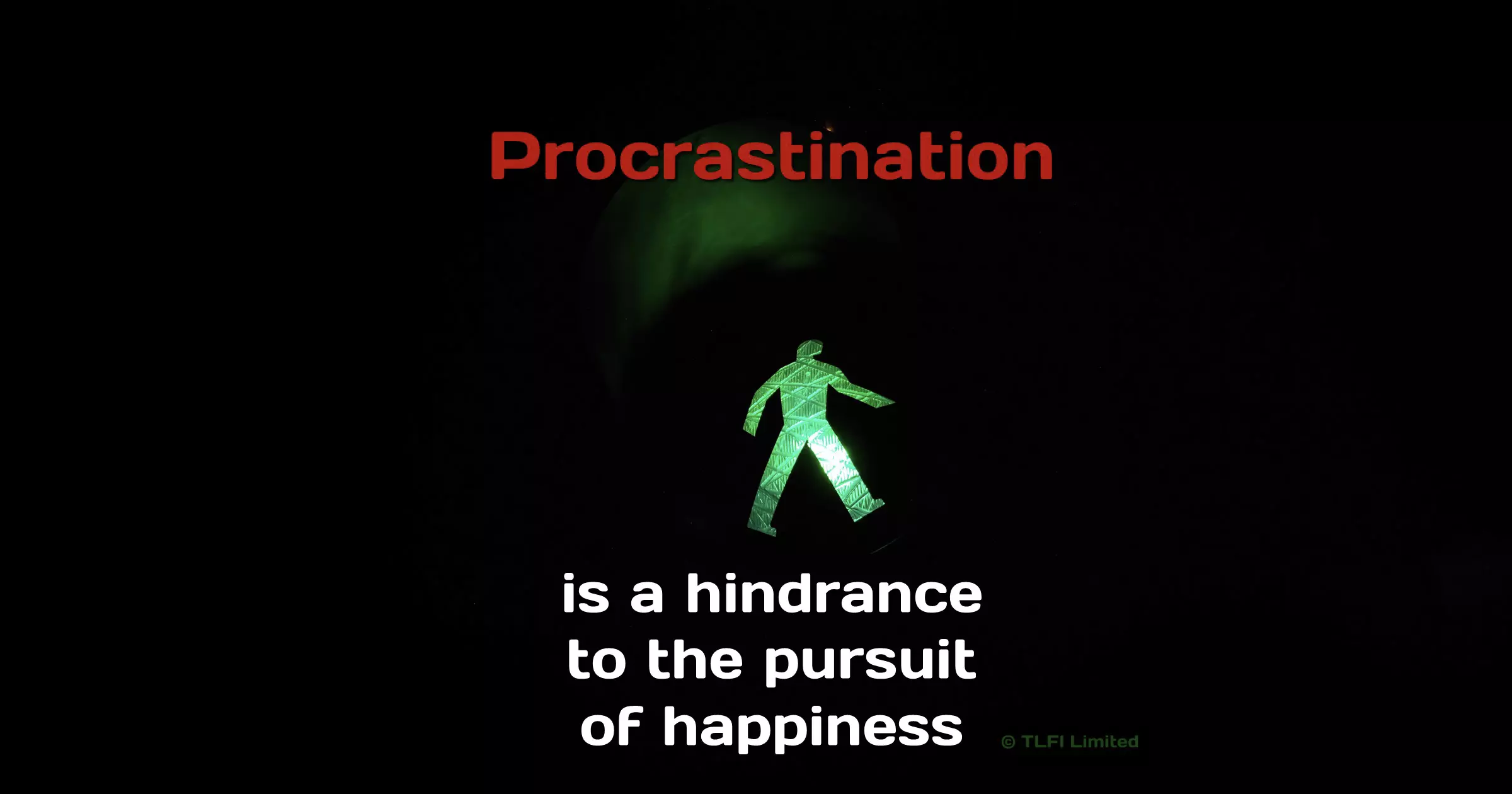
Procrastination, often dismissed as a harmless delay, conceals a significant impact on your well-being and can affect your pursuit of happiness. On the surface, procrastination, or delaying things may seem innocent. However, the crux of the matter is that procrastination, rather than just getting on with things, can often lead to a hidden accumulation of energy, which in some cases can result in increased stress.

It is not uncommon to be faced with tasks which you may deem undesirable. In these situations, the mind naturally gravitates towards avoidance. This avoidance perpetuates delays and adds to the underlying emotional causality. The looming sense of “I don’t want to do this” can very quickly build to be a burden, amplifying the stress associated with the task at hand. This thinking pattern then creates a feedback loop, which not only delays the completion of necessary responsibilities but affects your emotional well-being.

Addressing procrastination requires a proactive approach. By confronting the task head-on, you can liberate yourself from the grip of avoidance, unravelling the knots of stress that hinder your path to happiness. Tackling necessary tasks, not only frees up mental space, but also creates a sense of accomplishment. The release from procrastination allows for a redirection of energy toward more enjoyable aspects of life, fostering a positive cycle where the pursuit of happiness becomes an achievable endeavour.

Your World in Your Mind

The perception of the world around you is greatly influenced by the state of your mind as you experience the world through your mind. These perceptions are not mere reflections of the outside world, but are powerful filters on life. The lens through which you view the world is shaped by the state of your own consciousness.

This symbiotic relationship between internal states and external experiences highlights the pivotal role of perception in shaping our interpretation of reality. This important fact acknowledges that your inner landscape, teeming with thoughts, emotions, and feelings acts as the master painter, imparting hues and tones to the canvas of your reality.

Once you become more aware that your mind colours your perceptions of the world around you, you can begin to appreciate how these perceptions can be altered. If your mind is clouded with negative or despondent thoughts, the world may be manifest in a gloomy hue. Conversely, when your mind is filled with happiness, the world will take on a similar positive outlook.

By understanding the profound impact your mind can have in your life, you can take the opportunity to alter or recolour your perceptions. You are capable of changing the ordinary into the extraordinary and shaping a world that resonates with the vibrancy of your innermost thoughts and emotions.