Astrology Reimagined: Discover the Truth

Are you ready for a more truthful astrology and explore the cosmos with Astronomical Astrology? To gain a more accurate understanding of life’s energies, Astronomical Astrology considers the actual dimensions of the eighteen constellations traversed by the Sun, Moon, and planets, using the IAU’s observable boundaries rather than the simplified, equal segments of traditional astrology. This approach acknowledges the varying sizes of constellations (e.g., Pisces being larger than Cancer) and the different amounts of time celestial bodies spend within each due to their inclined paths. Why settle for simplicity when the universe’s true complexity can deepen your understanding? This provides a more nuanced and truthful understanding of astrological influences, offering deeper insights into personal energies and life patterns based on the true cosmic landscape.

Finding True Astrology

Astrology has been steeped in misunderstanding, confusion, dogma and even superstition for many years. Yet it strangely is discussed as being separate from the scientific discipline of astronomy and the actual observation of the sky and stars. With True Astrology, these two seemingly inharmonious areas of knowledge are combined, bringing into view astrology backed by precise and scientific knowledge to yield the indisputable observations of the Sun, Moon and planets throughout the skies. This extraordinary form of astrology takes into consideration the complete motion of the planets and the stars, factoring in the precession of the equinoxes and other real-world phenomena.

The awareness, understanding and comprehension of the energies which continually affect and influence you are pivotal to grasping how you live your life. The energies which are patterned by the Sun, Moon and planets as they transit through the constellations influence you and form the basis of True Astrology .

The Constellation Dimensions

To form a more accurate picture of the energies of life it is necessary to look at the dimensions of the eighteen constellations that the Sun, Moon and planets traverse. The astronomical constellations which are observable in the sky are not divided into the twelve neat and equal segments as typically defined in astrology.

To define the constellation dimensions, Astronomical Astrology uses the constellation boundaries as defined by the International Astronomical Union (IAU) and which is observable in the night sky. The most noticeable difference to other forms of astrology, is that not all constellations are of the same dimension. As an example, the constellation Pisces occupies a much larger space of the sky than the constellation of Cancer. The cosmos add complexity as the inclined path through each constellation results in the Sun, Moon and planets each spending different amounts of time travelling through each astronomical constellation.

Considering these two aspects, each constellation fills varying arcs of the sky. This varies quite significantly from 6.5 days for Scorpio to almost 45 days for Virgo. Tying the constellation dimension complexity into the precession of the equinoxes, means that Astronomical Astrology aligns exactly with the observable universe and science.

What is Precession of the Equinoxes

This phenomenon of the precession of the equinoxes is due to the long term cyclic wobbling in the orientation of Earth’s axis of rotation. This wobble of 1 degree for every 71.6 years was identified by Sir Isaac Newton and has since been better quantified as we have learnt more about the mechanics of the Solar System. We now know that the precession is caused by the gravitational effects of both the Sun and the Moon coupled with the fact that our planet is not a perfect sphere. Consider that the Earth is tilted and that the Sun’s gravitational pull is stronger on the portion that is tilted towards it, thus creating a torque effect on the planet. This torque coupled with the gravitational effects of the moon, which is tilted out of the plane by five degrees, causes the slow but very gradual wobble of the Earth.

The precession of the Earth’s axis has several noticeable effects. The first noticeable effect of this is that the positions of the north and south celestial poles appear to move in circles. The celestial poles take 25,772 years to create a full circle against the backdrop of seemingly fixed stars. Today, the star Polaris lies approximately at the north celestial pole, this will change over time as other stars become the north star. Second, the precession of the equinoxes moves slowly westwards across the sky, causing a drift in the observed position of the astronomical constellations. What this means is that each astrological star sign now contains the constellation that was formerly to the east. As an example, the tropical astrological star sign of Capricorn now covers a sector of the sky which is filled with the astronomical constellation of Sagittarius.

The location of the vernal equinox has shifted approximately 23 degrees westward over the past 2,000 years, will continue to progress westward at approximately 50.3 arc-seconds each year. When the astronomer Ptolemy mapped 48 constellations in the second century, the vernal equinox occurred in the constellation of Aries. Now due to the continued process of precession, the location of this equinox has shifted westward so that the vernal equinox now appears in the constellation of Pisces. This can be proven by simple observation of the night sky or the use of various apps on your smartphone which can map the stars.

The precession of the equinoxes is the prime reason for the difference between the true astronomical positions of the constellations and (western or tropical) astrology. Astronomical Astrology aligns with the science of astronomy and the real observations of the Sun, Moon and planets across the sky by factoring in the precession of the equinoxes.

Precession of the Equinoxes

The major difference between astrology and the observable astronomical constellations is due to the Precession of the Equinoxes. Astronomical Astrology takes into account the rotation, motion and orbits of the earth and planets to build a complete picture of the Galaxy at large.

You may ask, how does an equinox impact the position of the constellations? Equinox means “equal night”, being that time of year when all points on the Earth’s surface experience the same lengths of daylight and darkness. There are two equinoxes each year and the vernal equinox marks the point in time when the Sun crosses the celestial equator and is the beginning of spring in the northern hemisphere.

When Greek astronomer Hipparchus compiled his star catalogue in the year 129BC, he found that the positions of the stars did not match up with the older Babylonian observations. He observed that most of the stars and constellations had shifted a constant amount. This indicated to Hipparchus that it was not the stars themselves that had moved but the frame of reference, Earth, which had changed. Hipparchus concluded that the equinoxes were drifting westward along the ecliptic relative to the stars that were believed to be motionless from the perspective of astronomers, and opposite to the motion of the Sun along the ecliptic. The precession of the equinoxes is an ongoing process that has caused a shift in the position of the zodiac as seen from Earth.

Witness Five Planets in the Sky at Once

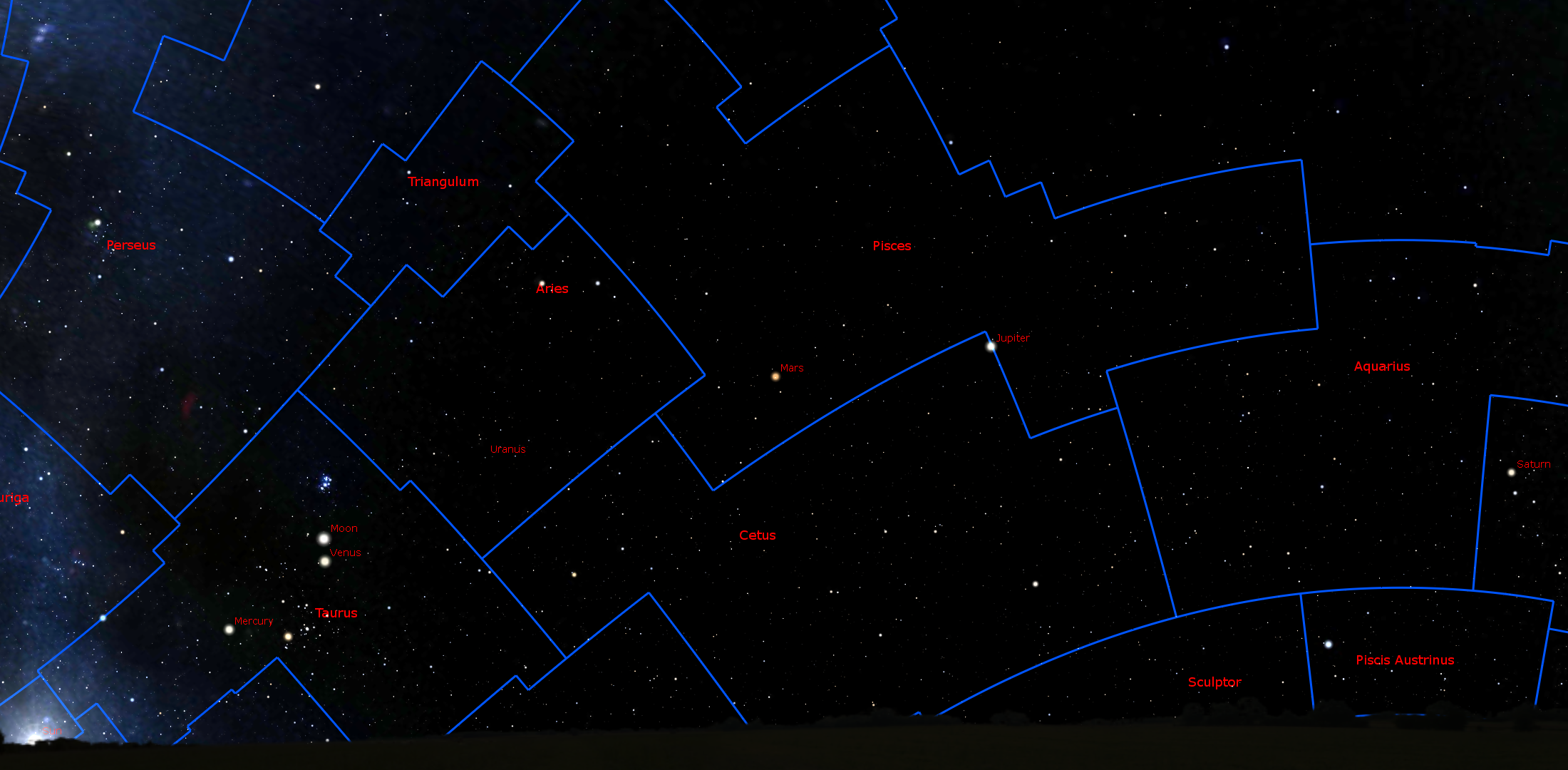
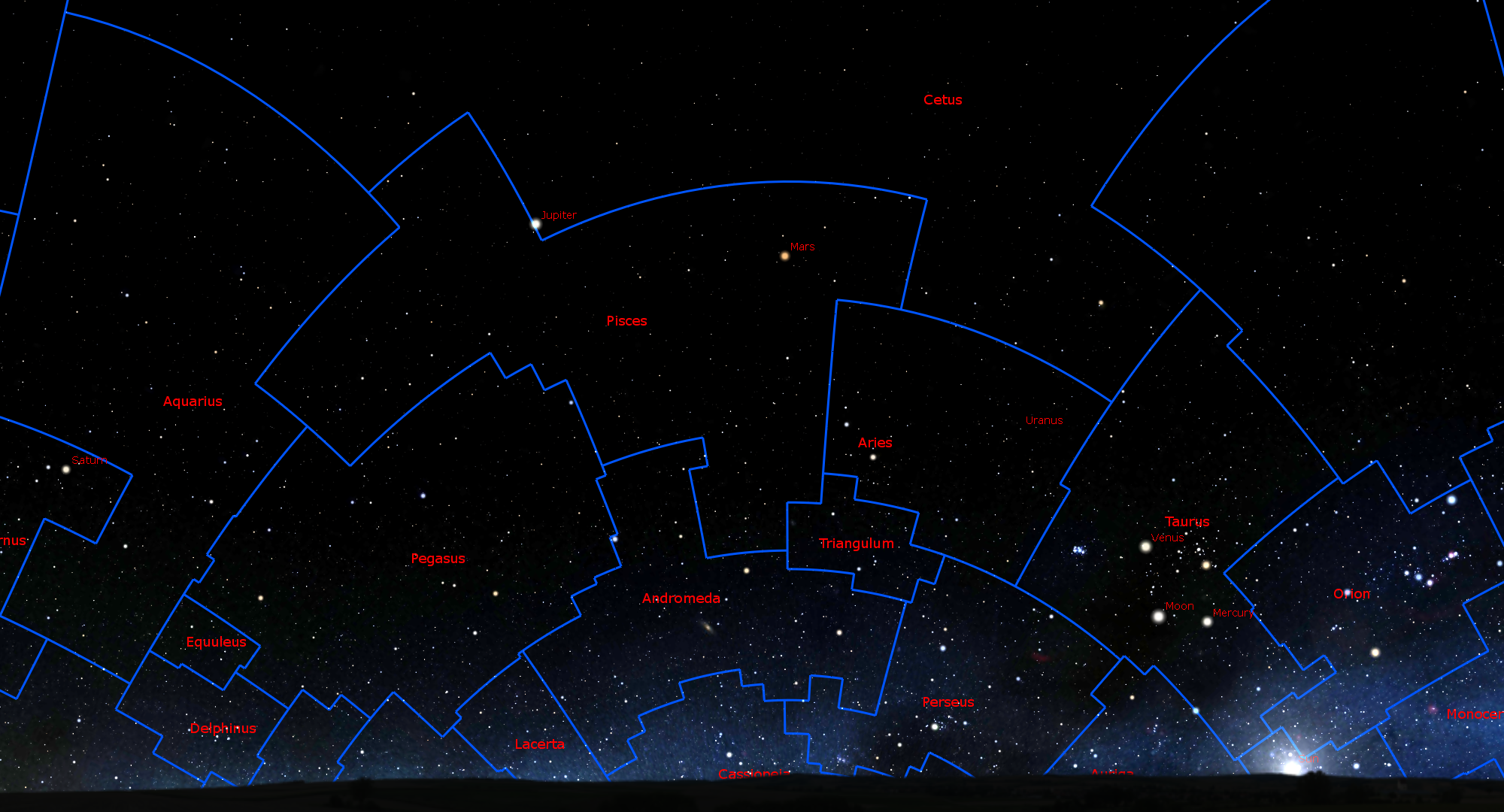
It is a rare and amazing opportunity to be able to see all five of these bright planets in the sky simultaneously. They will also be in the correct order outward from the Sun, starting with Mercury, Venus, Mars, Jupiter and ending with Saturn. The event last occurred in December 2004, but it was only visible in certain tropical areas.

You can see the Northern Sky as viewed at 5 am in London or you can see the Southern Sky as viewed at 7 am in Brisbane and zoom in to see the locations of Mercury, Venus, Mars, Jupiter and Saturn as they align in the true astronomical locations for the Zodiac.

The display will be visible until early July, so unless you experience an unbelievable string of bad weather, you should be able to view the amazing display. Light pollution is a potential, although likely minor issue. The best conditions are clear, dark skies but luckily, these are all bright, naked-eye objects so you should be able to see the line-up even from the city.

If you have a pair of binoculars or a telescope, point them at the planets and moon (but never the sun). With even a small telescope, or binoculars on a tripod, you can see Jupiter’s largest 4 moons and Saturn’s rings. If you are in a dark enough location with a small telescope, you might also be able to see the atmospheric bands in Jupiter’s atmosphere.